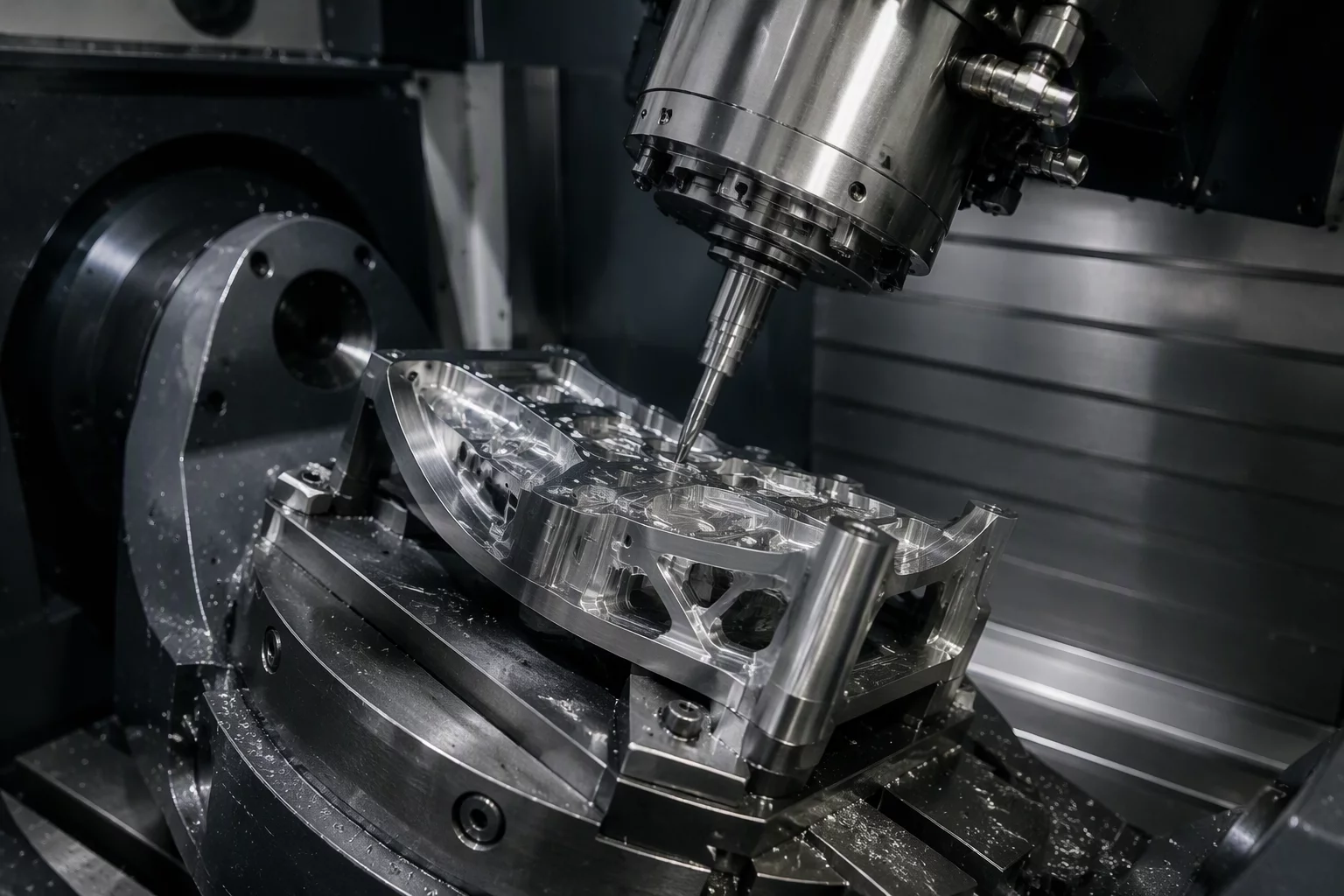
Documenting Toolpath Intent Around a Mastercam Workflow
An independent manufacturing guide to connecting part features, stock condition, machining purpose, tool selection context, and operation sequence around Mastercam programming.
Mastercam 2026 officially continues to advance programming workflows and tool management; 2026.R2 adds faster simulation, so this contextual workflow is well aligned with the real product. mastercam.com
"Roughing Complete — but What Should Remain?"
Where This Guide Ends and the Software Begins
Mastercam is the third-party CAD/CAM environment discussed in this guide.
ToolpathIntent Notebook is an independent educational publication focused on machining-operation purpose, feature access, remaining stock, sequence, and programmer handoffs.
ToolpathIntent Notebook does not provide Mastercam software, licenses, post processors, machine files, production NC code, official training, or technical support.
Examples describe machining reasoning and should not be treated as machine-ready parameters for a specific shop, machine, tool, or material.
ToolpathIntent Notebook is an independent educational resource and is not affiliated with or endorsed by Mastercam.
Mastercam is referenced for informational and educational purposes in published CAM workflow examples.
Semi-Annual Architecture & Runtime Milestones
Tracking toolpath calculation models across the standardized semi-annual cycle, linking geometry properties directly to post-processor output stability.
Mastercam 2026.R2 Launch
Standardized multi-threaded dynamic roughing enhancements, deep-pocket chip clearance loops, and validated feed deceleration along tight internal radii.
EverPath Beta Pipeline
Deployment of real-time residual stock mesh verification, reducing intermediate collision tests by integrating parametric CAD associativity.
Mastercam 2027 Production
Complete rollout of deterministic multi-axis tool vector control, unified containment envelopes, and native synchronized 5-axis collision checking.
Deterministic Toolpath Matrices
Filter operations based on manufacturing constraints, cycle mechanics, and cutter engagement targets.
Adaptive Stepover Pocketing
Maintains radial chip thickness constant through trochoïdal motion arcs, eliminating mechanical shock loads on solid carbide shanks inside pocket corners.
- Radial engagement: 9% to 15%
- Core depth: Up to 3.0x Cutter Dia
- Material: 4140 & Pre-Hardened Steel
Constant Cusp Surface Blending
Propagates passes inward and outward from reference guide curves to preserve an identical micro-inch surface finish across varying slope angles.
- Scallop height: 0.00015" (3.8 μm)
- Tool: Ball & Tapered Barrel Endmills
- Surface Target: 16 Ra Finish
Flank Swarf & Collision Bounds
Controls the cutting tool axis via double-rail spline guides, preventing holder interference against protruding fixture clamps while machining deep ribs.
- Holder clearance: 0.060" minimum
- Rotation axes: 4th & 5th Trunnion Table
- Vector tilt: Continuous dynamic smoothing
Step-Up Rest Stock Re-Machining
Combines large axial primary depth-of-cut with automated upward step-cutting, eradicating staircase volume remnants prior to semifinishing passes.
- Primary stepdown: 1.25"
- Step-up increment: 0.050"
- Stock model comparison: Active STL
UV Geometric Parametric Flow
Generates cutter tracking lines directly aligned with underlying CAD surface isocurves, preventing visible tool retract witnesses along cosmetic fillets.
- Surface contact: Continuous tangential
- Lead-in/out: Tangent arcs with overlap
- Feed rate: Direct inverse time G93
Deterministic Sequencing Order
Structurally arranges tool change frequency, datum recalibrations, and dynamic work offset (DWO/TCP) commands to minimize non-cutting spindle travel.
- Retract plane: Optimized minimum sphere
- Cycle savings: 18-24% rapid air time
- Safety index: Full G-code simulation
Associative Intent in CAM Trees
Writing durable CAM sequences requires documenting why an operation was selected rather than leaving downstream technicians to reverse-engineer cutter parameters from raw NC blocks.
"A toolpath without documented stock assumptions and radial chip limits is technical debt the moment revision B arrives at the shop floor."
Never reference raw CAD solids for rest roughing. Generate an explicit intermediate Stock Model after every bulk material removal operation to constrain rest-mill search boundaries.
Apply Mastercam High-Speed feed rate adjusting algorithms at tight internal radii to counteract spindle servo lag, preventing over-travel gouges on high-speed machining centers.
Assign dedicated clearance groups for toe clamps, vises, and bolt heads with non-negotiable safety offsets (minimum 0.080"), decoupling fixture safety from nominal work coordinate zeroes.
Continue Engineering Research
Roughing Cases
Constant-load pocketing, high-feed face milling, and dynamic chip thinning.
Finishing Cases
Scallop control, raster blending, and mirror-finish continuous flowlines.
Feature Access
Multi-axis reach, undercut reachability, and 5-axis collision boundaries.
Operation Sequence
Cycle time minimization, rotary axis windup control, and rapid efficiency.