Structuring Deterministic Links Across Machining Operations
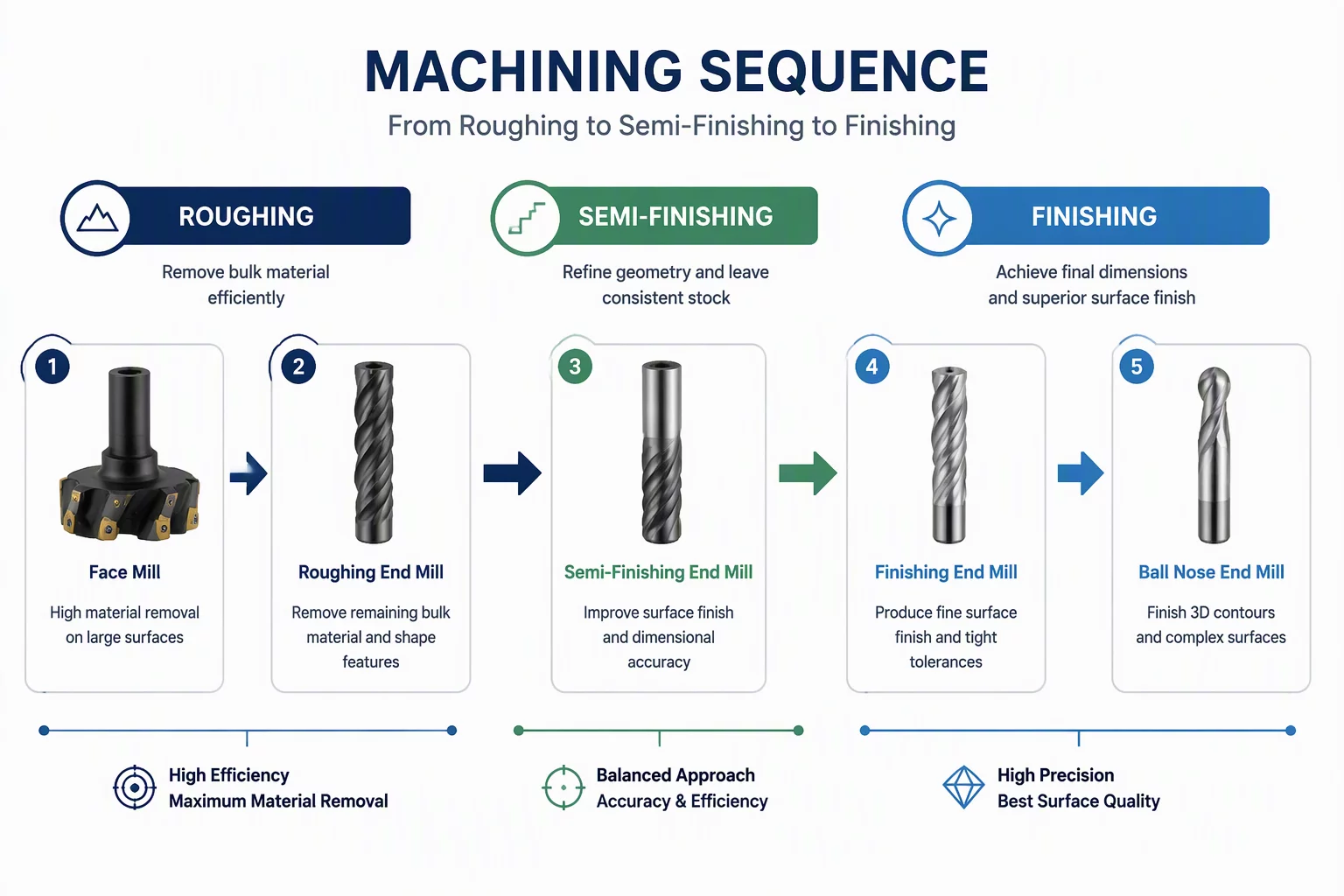
In CAM operation planning, no cutting pass functions in complete isolation. Every roughing or semi-finishing pass shapes the exact boundary conditions for subsequent toolpaths. Downstream operations rely entirely on accurate stock models left by previous cutters. Overlooking these geometric prerequisites leads to sudden cutter engagement spikes, premature insert failure, or redundant air cutting that inflates cycle times across batch runs.
Mastercam 2026.R2 and 2027 introduced refined in-process stock tracking capabilities that link operations directly to their predecessor models. Instead of estimating residual material through arbitrary bounding envelopes, modern sequencing forms an associative chain. When an upstream roughing tool removes core volume, rest roughing operations evaluate the remaining material volume with micron precision, protecting smaller cutters as they navigate interior corners.
Key Principles of Safe Machining Sequence Progression
Sound sequence architecture requires ordering toolpaths according to physical cutting dynamics rather than superficial CAD feature trees. Each successive tool requires predictable chip thinning, adequate chip evacuation clearance, and validated entry corridors.
- Associative Stock Models: Always generate intermediate stock models between major roughing and semi-finishing passes to prevent shock loads on smaller cutters.
- Clearance Envelope Verification: Ensure upstream passes mill away material around clamp towers and steep walls before shorter toolholders enter deep pockets.
- Deflection and Stress Mitigation: Balance heavy volumetric roughing passes before performing delicate wall semi-finishing to counteract workpiece stress relief.
Establishing these dependency controls results in reliable, lights-out machining workflows. Programmers verify cutter engagement prior to sending code to the shop floor, ensuring that every subsequent toolpath steps into a known, verified material envelope.