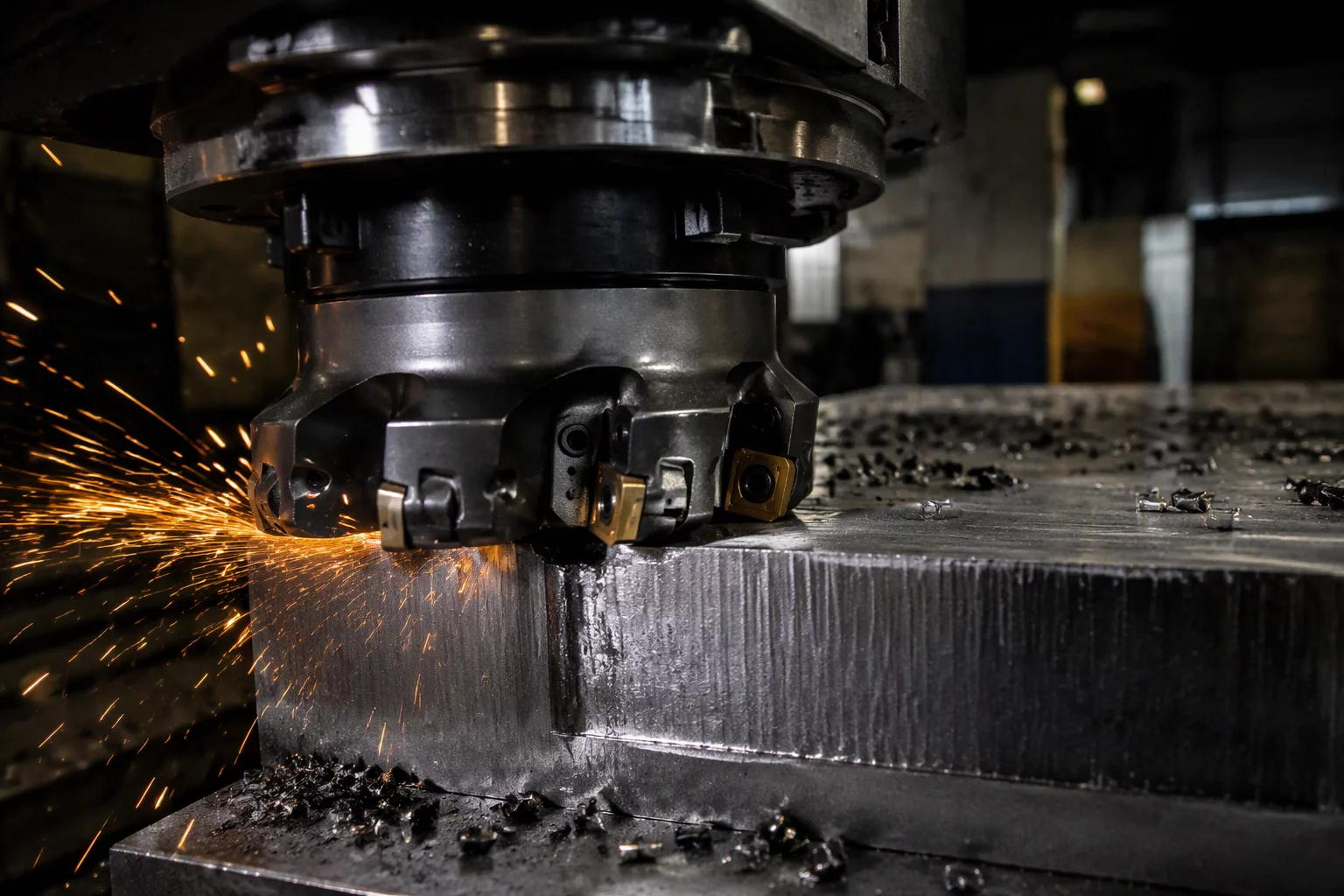
Managing Extreme Cutter Engagement Without Harmonic Chatter
Heavy cut operations demand a complete rethink of traditional speed and feed calculations. When pushing large indexable shoulder mills or porcupine cutters into pre-hardened alloys or structural steels, spindle torque limits become the deciding factor long before linear table feed hits its ceiling. Operating near the lower end of the machine's spindle motor RPM curve delivers maximum torque, allowing large-diameter cutters to shear stock smoothly without dropping RPM mid-engagement.
In high-rigidity CNC setups, taking deeper axial passes with conservative radial stepovers significantly reduces harmonic vibration compared to shallow, wide cuts. The forces push upward into the spindle bearings rather than deflecting the cutter sideways across the raw casting or billet. By distributing the cut across multiple insert flutes simultaneously, the tool body stabilizes inside the cut groove, yielding predictable chip thickness and uniform tool wear.
Core Directives for Deep Engagement Milling
Before committing high-feed or standard indexable tooling to heavy roughing cuts, verify every variable across your fixturing and spindle package:
- Match tool diameter to spindle taper: reserve heavy radial cuts greater than 50% for 50-taper or HSK-A100 spindles to resist lateral bending moments.
- Program constant chip thinning compensation to ensure the insert seat remains under steady compressive load through arc entries.
- Select heavy-rake geometry with tough submicron carbide substrates to prevent insert corner chipping during interrupted pocket entries.
In Mastercam 2026.R2 and 2027 workflows, linking dynamic motion entry arcs directly with feed deceleration around abrupt directional shifts prevents the sudden load spikes that crack carbide inserts during heavy pocket roughing passes.