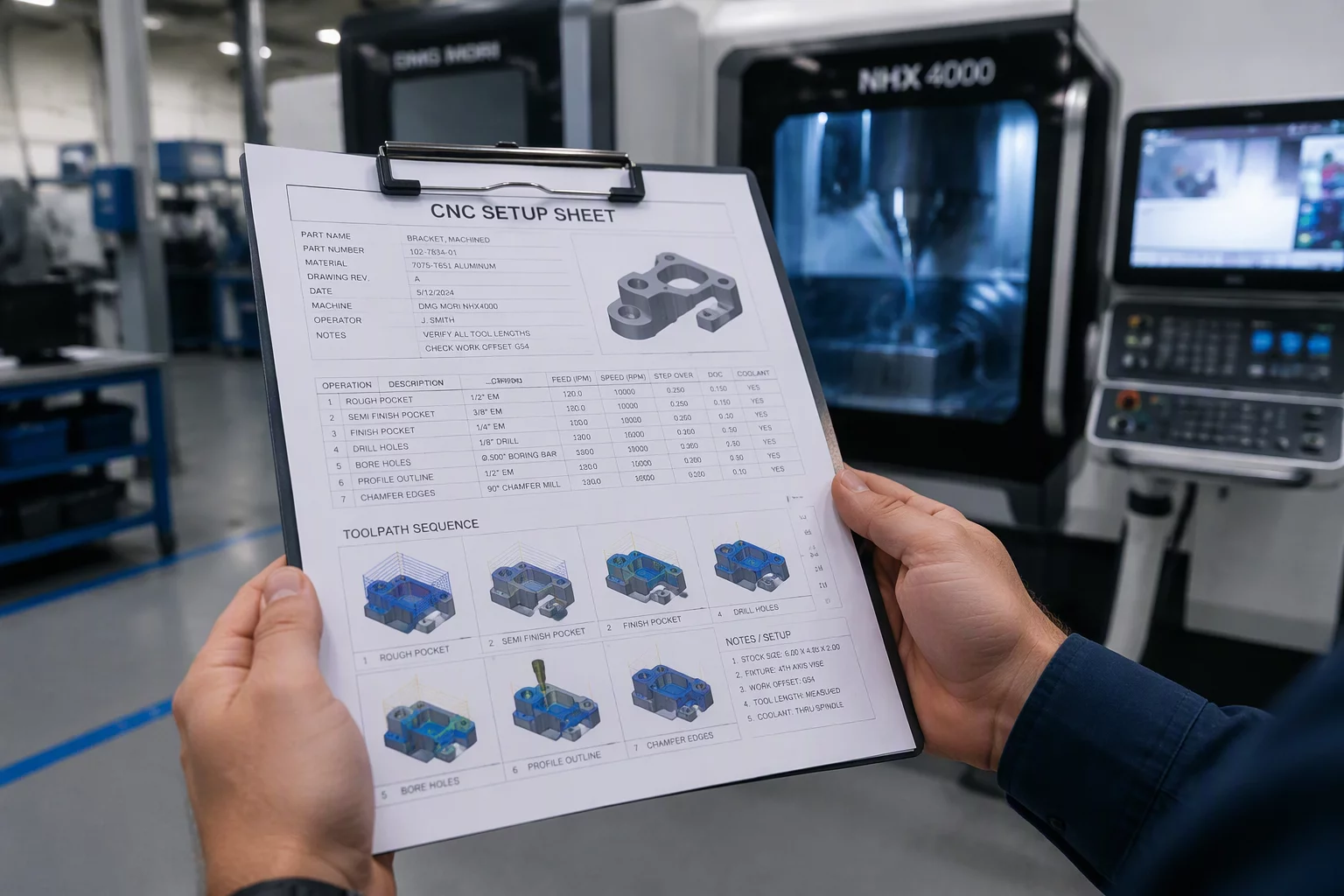
Deterministic Logic for Priority Sequencing in Production CAM
Machining sequence is rarely a matter of programmer whim; workpiece stability changes dynamically as bulk stock dissolves. Milling deep pockets before squaring datum faces introduces deflection errors that cascade across all subsequent operations. Operators face chatter, premature tool wear, and scrap when roughing loads hit unsupported thin walls. Prioritizing bulk roughing before semi-finishing while preserving stock envelopes around critical features guarantees structural rigidity throughout heavy cut cycles.
Modern toolpath engines like Mastercam 2026.R2 and 2027 rely on accurate in-process stock models to compute dynamic entry vectors. If operations appear out of sequence, the collision detection algorithms must evaluate unnecessary air cuts or fail to flag shank collisions during rest milling. A strict hierarchy prioritizes datum establishment first, heavy hogging passes second, semi-finishing third, and isolated precision details last.
Four Core Rules for Operation Tree Scheduling
Every operation assigned in the CAM manager must satisfy four functional priority rules before sending post-processed G-code to the machining center:
- Datum Priority: Machine locating faces, primary reference planes, and alignment bores before roughing interior cavities to eliminate coordinate drift.
- Volumetric Precedence: Complete high-volume stock removal with maximum cutter diameter before introducing smaller reach tools or rest-roughing passes.
- Wall Integrity Preservation: Leave sacrificial boundary stock on thin ribs and tall standing walls until interior floor clearing and heavy roughing finish completely.
Postponing finishing passes until all roughing stresses equalize prevents dimensional warping. In thin-walled aerospace housings or structural brackets, residual stress release causes measurable deflection if finish passes run prematurely. Applying these sequencing rules turns chaotic program trees into deterministic, collision-free toolpaths that run reliably across multiple machining shifts.