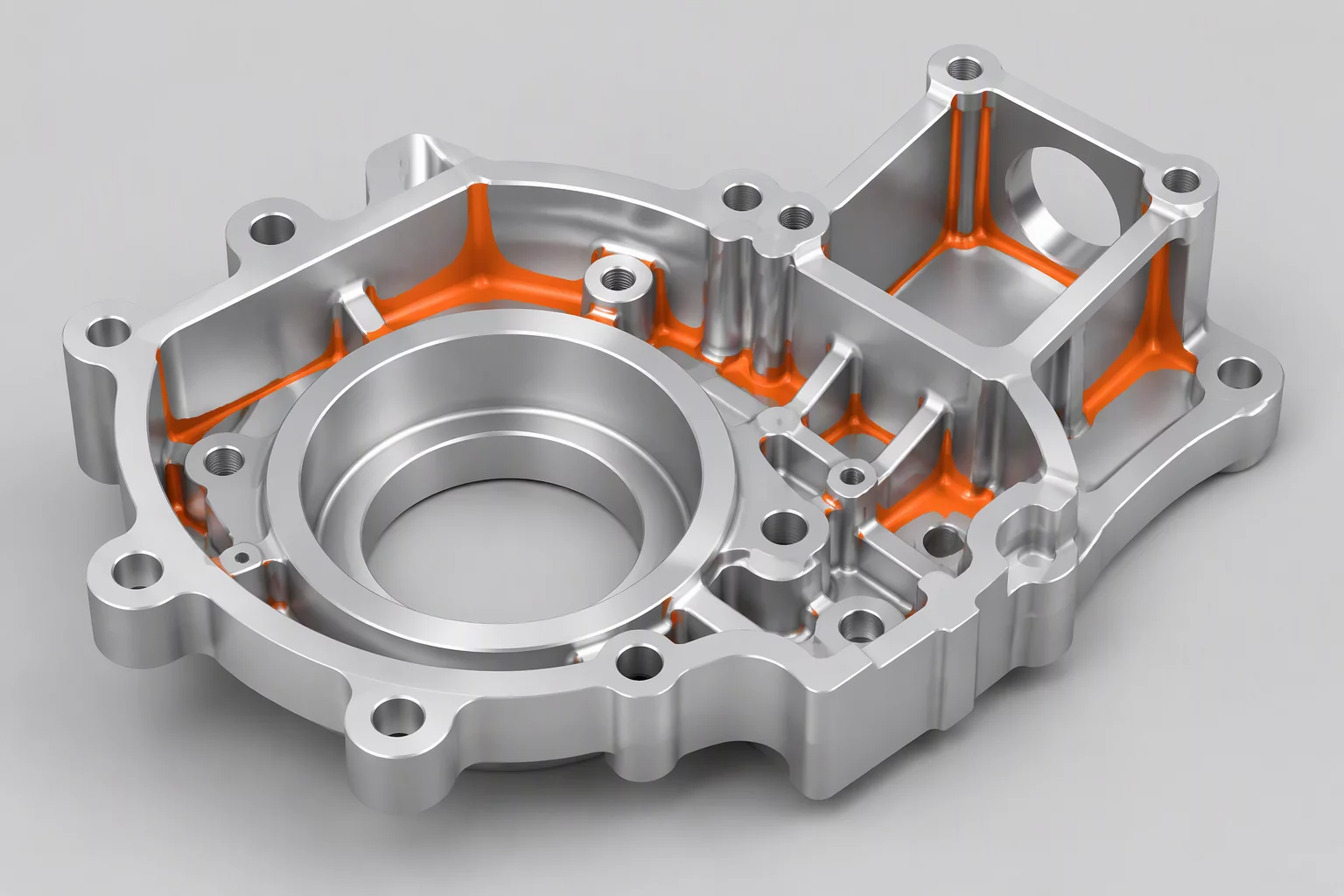
Why Roughing Must Leave Material on Purpose
Roughing is not about removing everything. It is about removing the right volume while deliberately preserving a controlled layer of stock for every downstream operation. When a programmer fires off a high-feed roughing pass without documenting how much material should remain on walls and floors, the next operation inherits an unpredictable surface. That unpredictability translates directly into tool deflection, chatter, and dimensional drift.
The intent behind leaving stock is not a side effect of tool diameter limitations. It is a conscious engineering decision. Floor stock protects the pocket base from tool pressure spikes during semi-finishing. Wall stock ensures that the finishing pass encounters a uniform radial engagement rather than a variable mix of air cuts and full-width plunges. Corner stock prevents small finishing tools from being buried in tight radii where chip evacuation is already compromised.
Documenting Stock Allowances as Operation Intent
In Mastercam 2026.R2 workflows, the stock to leave parameter is not just a number typed into a dialog box. It is a declaration of what the roughing operation is responsible for producing. If the floor stock allowance is set to 0.3 mm, the programmer is stating that the roughing pass will leave no less than 0.3 mm of material above the final floor geometry. This value must be documented in the operation notes so that the semi-finishing programmer knows the exact envelope they are starting from.
- Floor Stock Intent: Document the exact remaining stock thickness on horizontal surfaces. This value defines the starting condition for semi-finishing and prevents unexpected cutter burial on pocket floors.
- Wall Stock Intent: Specify the radial stock remaining on vertical walls. Uniform wall stock ensures consistent chip load during finishing and eliminates the risk of the tool rubbing instead of cutting.
- Corner Stock Intent: Acknowledge that large roughing tools cannot reach internal radii. Document the expected corner remnant volume so rest roughing can be planned as a deliberate operation, not an emergency fix.
When stock allowances are documented as intent rather than left as implicit assumptions, every downstream programmer can verify the starting condition without measuring the part. The roughing operation becomes a handoff with a clearly defined output state, not a black box that happens to leave some material behind. This is the difference between a process that is repeatable and one that breaks when the programmer changes.