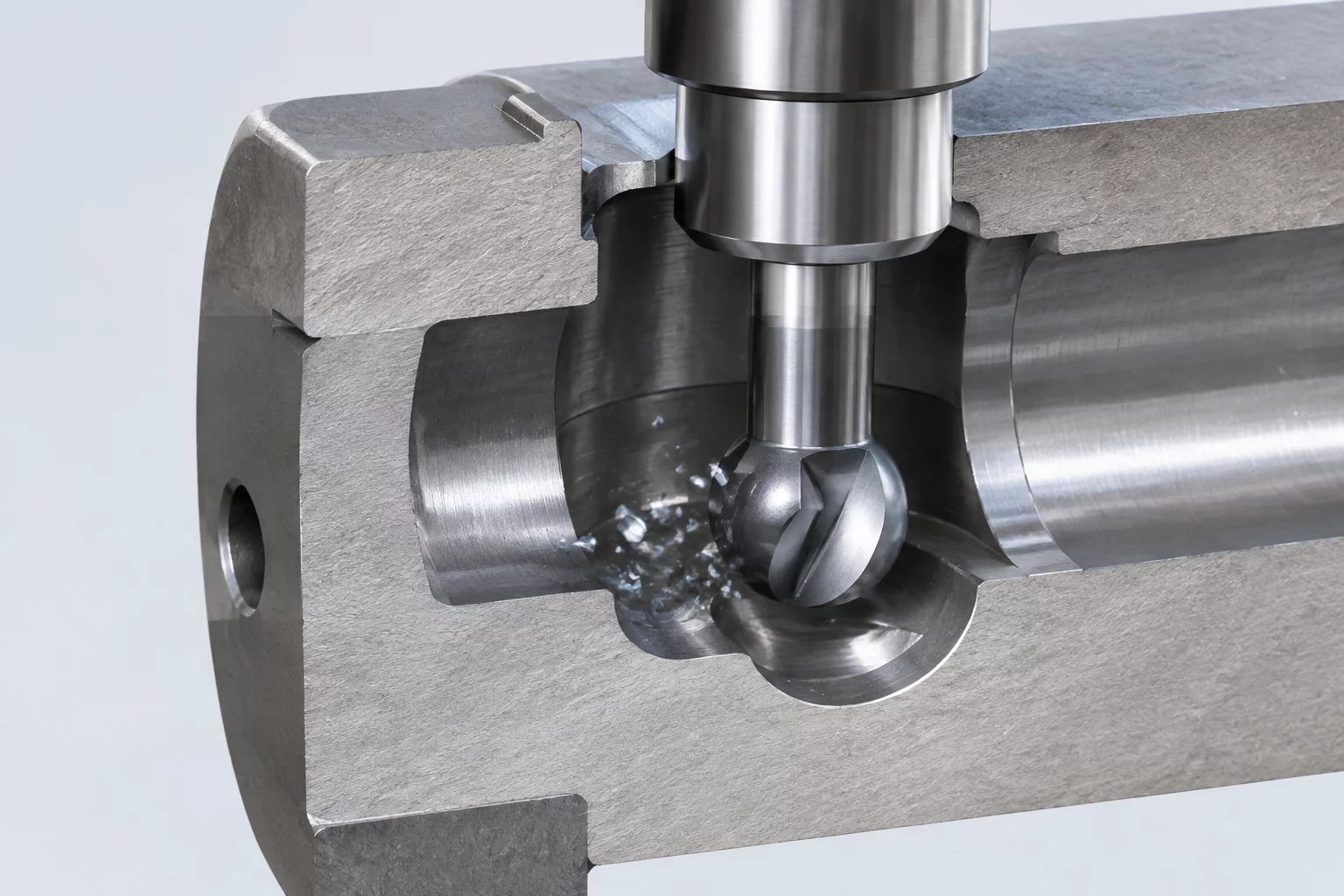
Access Is Not Intent: Separating Reach From Purpose
A cutting tool can physically arrive at a surface and still leave the feature unfinished. This is the central trap of multi-axis feature machining: the postures, clearances, and collision checks all return green, the tool tip touches the programmed geometry, and the operation is marked complete in the CAM tree — yet the actual machining intent remains unmet. Access answers only one question: can the cutter occupy the space? Intent answers a different one: does occupying that space produce the geometry, tolerance, and surface condition the drawing demands?
Programmers who conflate the two tend to verify toolpath with a single criterion — tool contact against the model surface — and ship the operation. On a three-axis prismatic part this shortcut usually survives because reach and purpose travel together. On a five-axis part with compound angles, undercuts, and features that depend on a specific tool vector, the shortcut breaks. The tool reaches the surface at the wrong inclination, with the wrong portion of the cutter, or along a trajectory that leaves scallop, mismatch, or stock that a downstream operation cannot clean. The surface was touched; the feature was not made.
How a Tool Reaches Without Fulfilling the Intent
Several failure modes share the same outward symptom — the toolpath verifies clean and the cutter touches the surface — while the underlying intent is quietly lost. Recognizing each one requires looking past the collision report and into the geometry the toolpath actually leaves behind.
- Wrong tool vector at contact: the cutter reaches the surface but at an inclination that engages the wrong flank of the insert, producing an incorrect wall angle or a blended fillet that no longer matches the CAD model.
- Insufficient reach depth: the tool tip grazes the upper surface of a pocket floor but stops short of the programmed Z, leaving a residual stock island that the verify simulation dismisses as a minor scallop.
- Back-plot without in-process stock awareness: the toolpath is generated against the nominal model rather than the actual remaining stock, so the cutter reaches the surface but cannot remove the material the previous operation left behind.
- Tool assembly substituted at setup: a shorter or differently necked tool reaches the surface but lacks the overhang to machine the full depth, and the intent card is never re-checked against the new assembly.
Each of these passes a reach check and fails an intent check. The discipline is to treat access verification as a necessary but insufficient gate, and to follow it with an explicit intent audit: does the toolpath, as generated, produce the feature the drawing defines? In Mastercam this means reviewing the back-plot against in-process stock, confirming the tool vector against the feature's nominal normal, and validating that the final pass leaves the specified surface finish rather than merely contacting the surface.