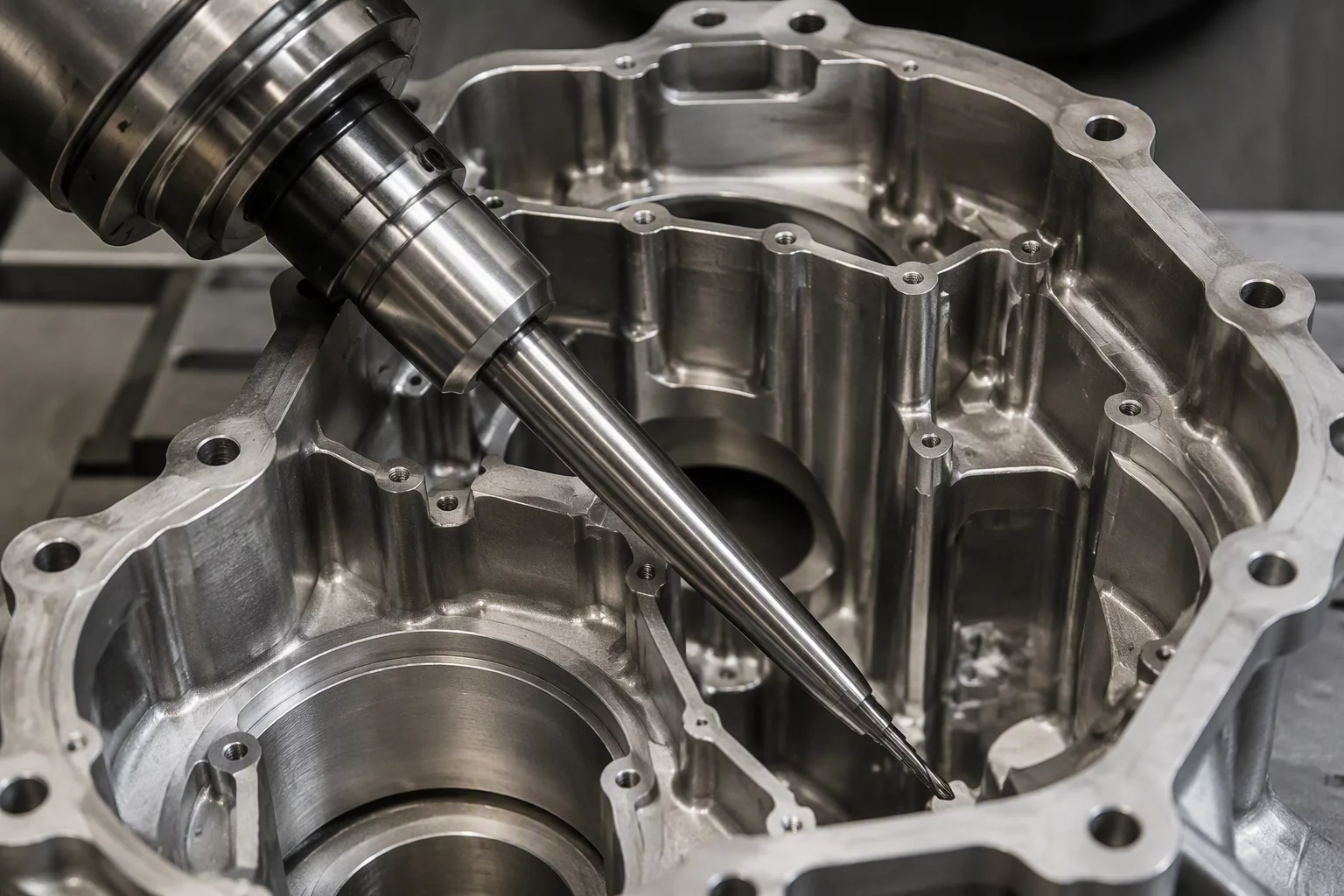
When Material Removal Is Mistaken for Feature Completion
A toolpath that sweeps through a pocket and clears stock from the region has, by definition, removed material. What it has not necessarily done is complete the feature. Feature completion is a separate, verifiable condition that demands the finished geometry match the design intent within tolerance, with no residual stock, no uncut corners, no insufficient floor depth, and no missing secondary operations such as chamfers or threads. Conflating the two states is one of the most persistent reasoning errors in CAM programming, and it is the reason parts arrive at inspection with pockets that look machined yet fail dimensional verification.
The distinction matters because a toolpath is a motion plan, not a result. A roughing routine can execute every move in its toolpath, consume the expected cycle time, and leave behind scallops, corner fillets, and floor stock that exceed the finish allowance. A finishing pass can follow the contour precisely and still leave material in regions where the tool could not reach due to diameter, corner radius, or holder collision. In each case the toolpath completed; the feature did not. Without explicit completion verification, the operation sequence reports success on a feature that is physically unfinished.
Systematic Rules for Verifying Feature Completion
Resolving the gap between material removal and feature completion requires deliberate verification steps layered on top of the toolpath, not assumptions based on whether the operation ran green. Every feature class dictates a specific combination of stock comparison, rest machining, and geometric verification:
- In-Process Stock Comparison: Run a verify or stock model comparison against the design solid after every operation, not only at the end of the sequence, to detect residual material exceeding the finish allowance before the next tool is committed.
- Rest Machining Detection: Identify regions the previous tool could not reach due to diameter or corner radius and generate an explicit rest mill operation, ensuring corners and tight radii are cleared rather than assumed finished by the larger cutter.
- Floor and Wall Depth Verification: Confirm that pocket floors reach nominal depth and that walls meet verticality and surface finish requirements, since a toolpath that stops short of the floor leaves a feature that is materially incomplete regardless of how clean the walls appear.
Proper toolpath intent links every operation back to an explicit completion criterion rather than to the fact that the tool moved. As material clears during roughing, the in-process stock model reveals exactly where the feature remains unfinished, whether that is a corner radius the rougher could not enter, a floor left 0.2 millimeters proud, or a chamfer that was never programmed. Tracking these residual conditions prevents programmers from declaring a feature complete the moment the toolpath finishes running, and forces a verification step that closes the gap between motion executed and geometry achieved.