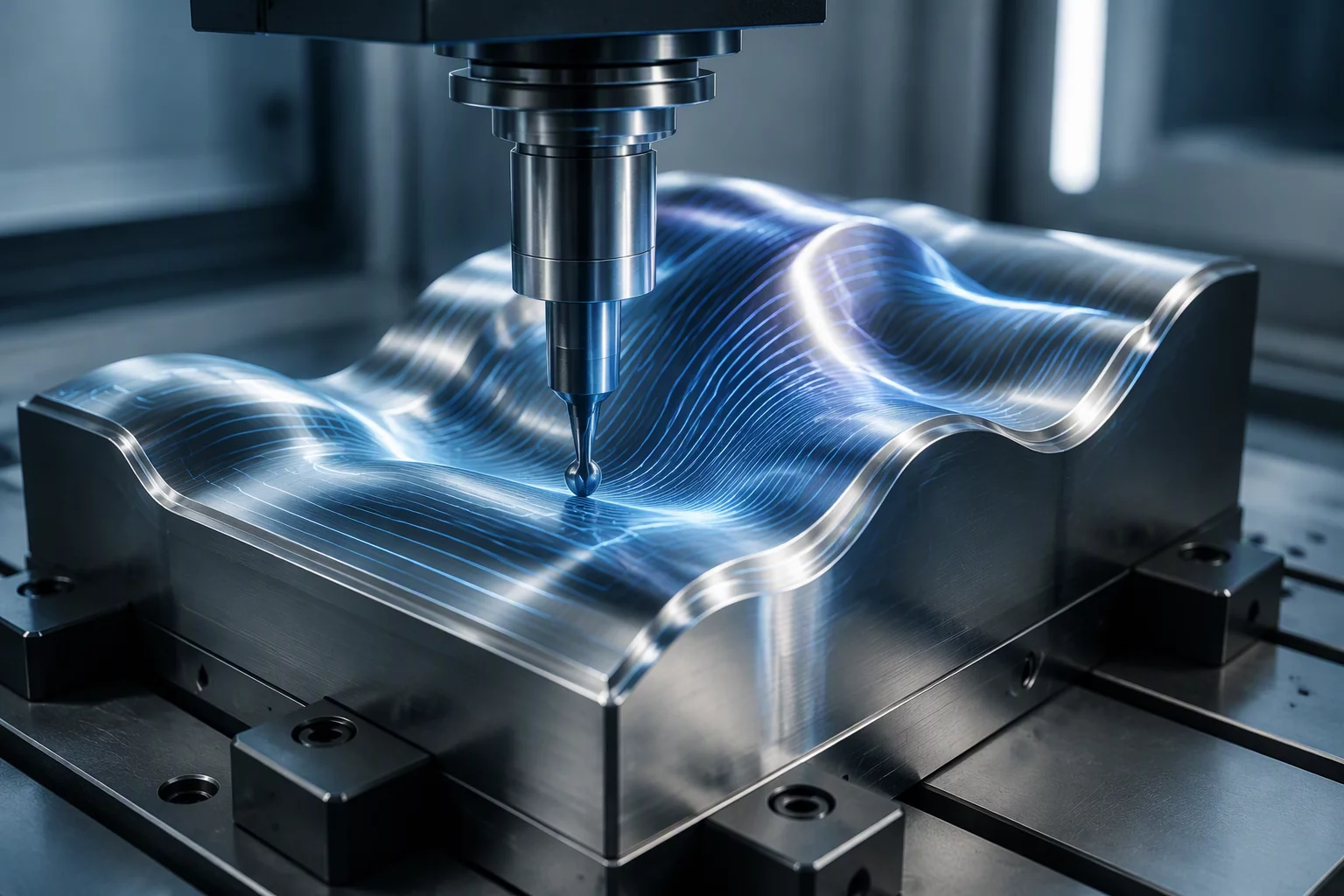
Why a Finish Pass Defines Geometry, Not Just Finish
In precision CNC machining, the finish pass is frequently mischaracterized as a purely cosmetic operation whose sole purpose is improving surface roughness. In reality, on parts that carry dimensional tolerances, mating datums, or sealed interface grooves, the finish pass is the operation that locks in the actual part geometry. The semi-finish stock left behind by prior roughing and profiling cycles is not merely excess material to be polished away; it is the buffer that absorbs roughing deviation, tool deflection, and thermal drift. The finish pass consumes that buffer toestablish the final walls, floors, corner radii, and blend curves that the inspection report will be measured against.
When a finish pass is treated as a geometry decision rather than a finish decision, the programmer's priorities shift. Stepover and stepdown are no longer chosen only to minimize scallop height; they are chosen to control where the tool engages relative to the nominal surface so that the resulting feature boundaries land inside the tolerance band. In Mastercam 2026.R2 and Mastercam 2027, this means leveraging stock-aware finishing strategies, boundary-driven flow paths, and verify-in-process stock models so the final pass removes a known, uniform chip rather than chasing an already-oversize surface.
Dimensional Accuracy and Mating Interface Conformance
For mating components, the finish pass is what determines whether two parts assemble, seal, and function as designed. A bore finished with a spring-pass that leaves a taper of even 0.02 mm can reject a precision shaft fit. A pocket floor finished with inconsistent stock allowance can shift a datum plane and cascade into stack-up failure across an entire assembly. Treating the finish pass as a geometry decision means the programmer enforces the following priorities before the NC file is ever posted:
- Define the finish pass stock allowance against the verified in-process stock model so the tool removes a predictable chip of 0.05 mm to 0.15 mm, eliminating spring-back and taper on critical walls.
- Lock feature boundaries, corner radii, and blend tangencies to the nominal CAD model so the finish pass establishes the true mating geometry rather than approximating it from roughing leftovers.
- Sequence spring passes and lead-in lead-out moves to neutralize tool deflection, holding dimensional conformance within ±0.01 mm on bores, pockets, and sealed interface grooves.
When these parameters are enforced, the finish pass stops being a gamble against roughing error and becomes a deterministic geometry-defining operation. The resulting parts pass first-article inspection on dimensional criteria, not just surface finish callouts, and the mating interfaces conform to their design intent without manual rework or hand-fitting at assembly.