Why the Next Operation Depends on What This One Leaves Behind
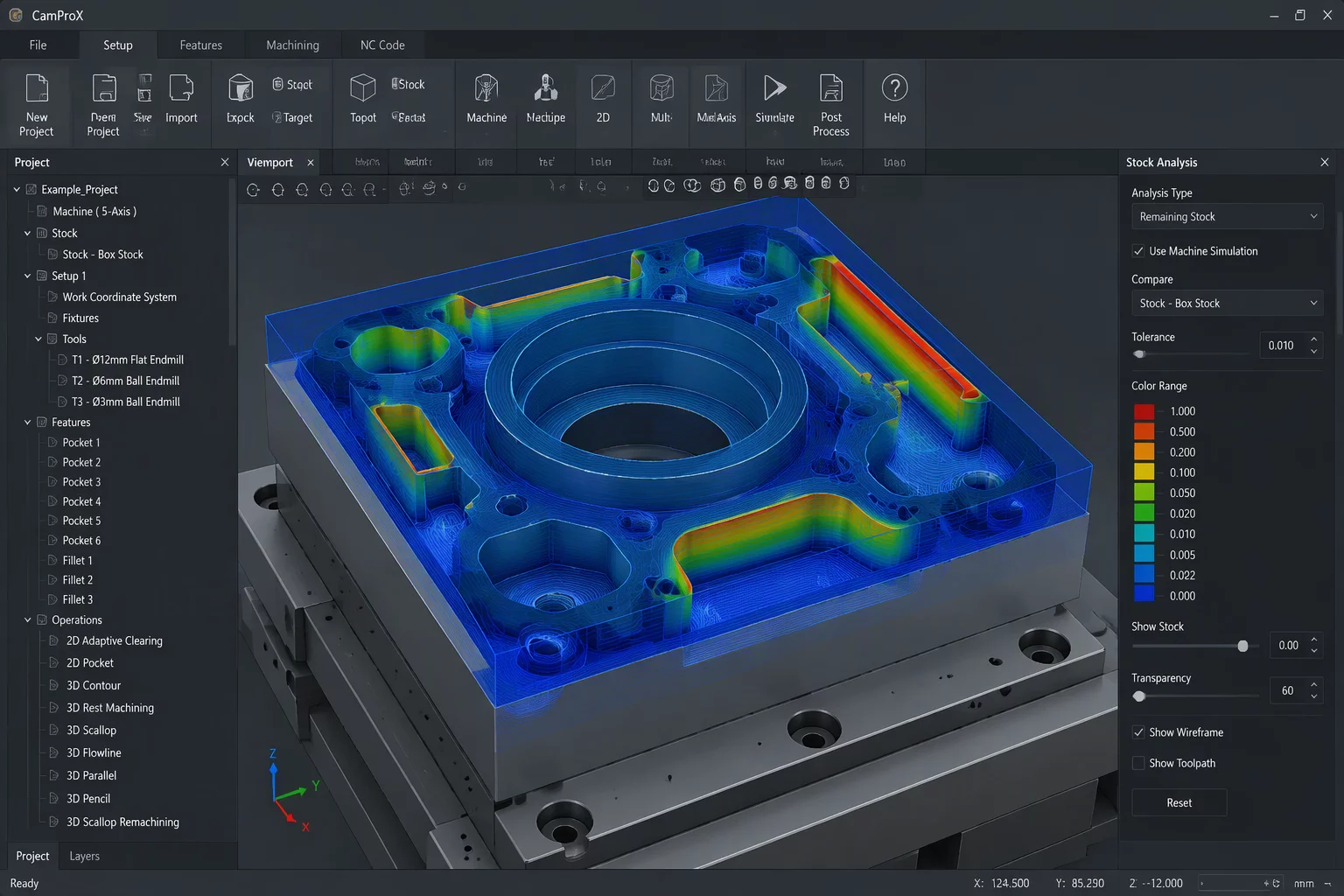
Every CNC operation is a contract between what the previous toolpath removed and what the next toolpath expects to find. The material left behind by one operation is not a byproduct to be tolerated; it is the precise geometric input condition that governs every engagement calculation, every feed override, and every collision check in the downstream sequence. When programmers treat remaining stock as an afterthought, they break that contract, and the next cutter inherits a workpiece state it was never programmed to handle.
Consider a typical roughing-to-semi-finish handoff. The roughing end mill removes the bulk of the volume but leaves corner remnants, scallop ridges, and floor steps dictated by its own diameter, stepdown, and engagement limits. The semi-finishing toolpath is then generated against that remaining stock, not against the original billet. If the roughing operation leaves a 3 mm corner remnant where the semi-finish pass expects a uniform 0.4 mm wall allowance, the smaller cutter plunges into seven times the intended radial depth of cut. The result is chatter, deflection, accelerated insert wear, and in the worst cases a snapped carbide shank that scrapes the part on its way out.
This is why documenting what each operation leaves behind is a non-negotiable discipline in any deterministic CAM workflow. The remaining stock model is the handoff artifact. It is the single source of truth that tells the next operation exactly what geometry it will encounter, where the material is thick, where it is thin, and where it is already absent. Without that documented handoff, every downstream toolpath is a guess.
Documenting the Stock Handoff Between Operations
A rigorous stock handoff protocol records the state of the workpiece at the boundary between every operation in the CAM tree. This is not merely saving a stock model file; it is annotating that model with the conditions that produced it and the conditions it imposes on what follows. Programmers should establish the following checkpoints after each critical operation group:
- Record the remaining wall and floor allowances left by the current tool, including the maximum corner remnant thickness measured against the next operation's intended radial stepover.
- Verify that no region of the stock model contains negative stock or gouges introduced by rapid retracts, lead-in arcs, or holder clearance moves that the next toolpath would inherit blindly.
- Confirm that the floor-to-wall junctions left behind provide continuous, predictable engagement for the next cutter, so that a ball-nose or tapered tool does not encounter sudden step transitions that spike radial load.
- Lock the verified stock model as the explicit input boundary for the next operation, so the downstream toolpath calculates feeds, stepovers, and collision avoidance against true remaining geometry rather than a nominal stock envelope.
When this handoff is documented and enforced, the CAM tree becomes a chain of accountable operations rather than a stack of independent guesses. Mastercam 2026.R2 and 2027 support this discipline by carrying verified in-process stock meshes forward as dynamic rest boundaries, allowing each subsequent toolpath to reference the exact material state the previous operation produced. The next operation no longer assumes a clean billet; it reads the documented handoff and programs itself against the reality of what was left behind.